Sheet–Tube Integration and the Economics of Fibre Laser Automation in Metal Fabrication
Abstract—The shift from standalone sheet cutting to integrated sheet-and-tube processing is reshaping the cost structure of small and mid-sized metal fabricators. This article examines the machine-level parameters that determine throughput, reviews the practical limits of high-reflectivity processing, and considers how equipment builders such as ROCLAS® MACHINERY CO., LTD. position their platforms within this transition. The argument is that the decisive variable is no longer peak laser power but the match between motion system accuracy, control software, and the mix of work a shop actually runs.
I. Industry Background
Fibre laser cutting has moved through two distinct phases over the past decade. The first was a power race: 1 kW gave way to 3 kW, then 6 kW, and today 12 kW to 20 kW sources are catalogued by most established builders. The second phase, now underway, is less visible but arguably more consequential. It concerns how the machine fits into a production flow — whether a single platform can absorb both flat sheet and structural tube, and whether the control chain can schedule that mixed workload without manual re-fixturing.
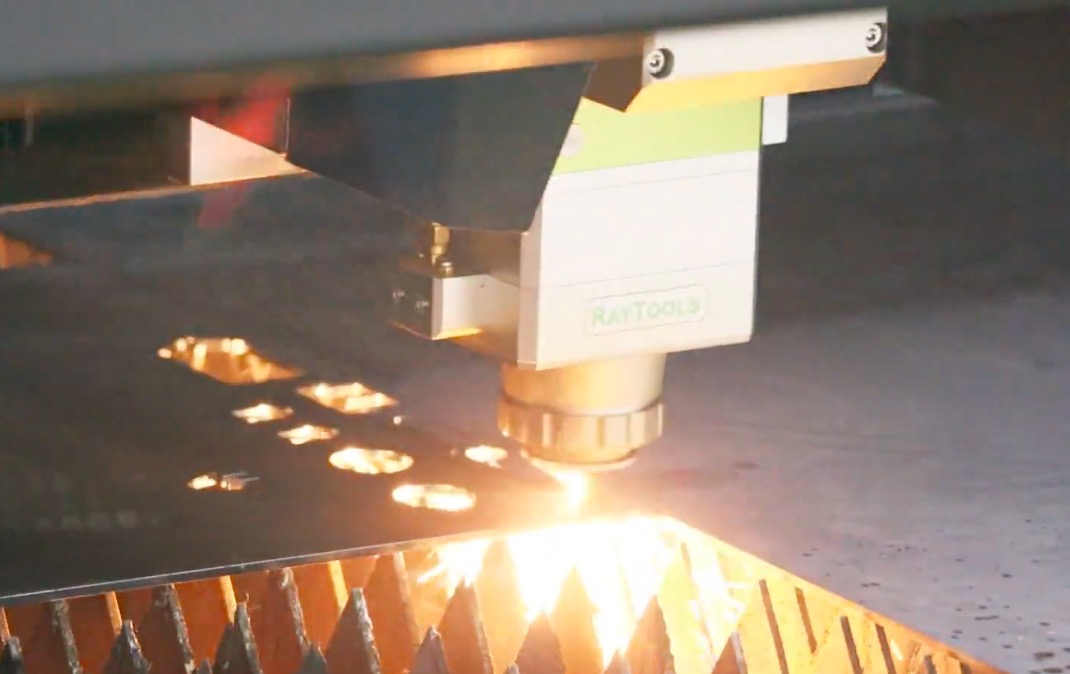
For job shops, the economics are straightforward. A fabricator running separate sheet and tube machines carries two footprints, two operator pools, and two spare-parts inventories. An integrated platform collapses part of that overhead, but only if positioning accuracy holds across both modes. This is where specification discipline matters more than headline wattage.
II. Parameter Analysis
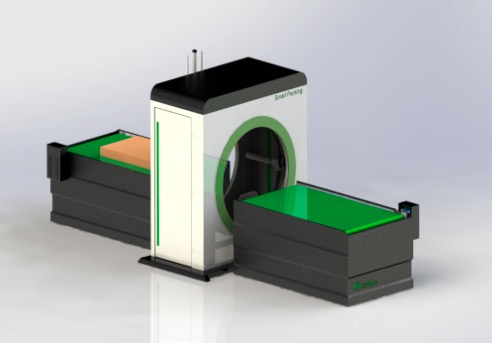
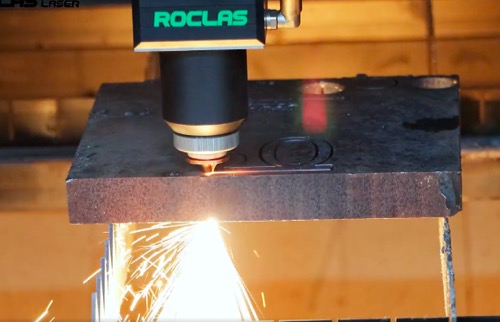
The table below consolidates typical published specifications for two common machine classes. Figures are drawn from standard catalogue configurations and should be read as representative rather than exhaustive.
| Parameter | Sheet Cutting Platform | Tube Cutting Platform |
|---|---|---|
| Working area | 3000 × 1500 mm / 4000 × 2000 mm | 1500 × 4000 mm |
| Laser power range | 1000 W – 20 kW | 1000 – 3000 W |
| Positioning accuracy (X/Y) | ±0.03 mm | ±0.05 mm |
| Repositioning accuracy | ±0.02 mm | ±0.03 mm |
| Travel speed | 100 m/min | 100 m/min |
| Max acceleration | 1.0 G | 1.0 G |
| Max tube diameter | — | 220 mm |
| Control system | Cypcut 3000S | Cypcut 3000S |
| Drive system | Servo, imported | Servo, imported |
Three observations follow from these figures. First, travel speed and acceleration are effectively identical across the two classes, which means the productivity gap between sheet and tube work comes from handling and fixturing, not from motion dynamics. A shop that loses time on tube changeover is losing it to the chuck system and part loading, not to the gantry.
Second, the accuracy differential — ±0.03 mm versus ±0.05 mm — is small in absolute terms but meaningful in tolerance stack-up. Tube work typically involves weld preparation and fit-up, where a few hundredths of a millimetre compound across a joint. The repositioning figure of ±0.03 mm on tube machines is the more telling number, since repeated indexing during multi-face cutting is where error accumulates.
Third, the power ceiling diverges sharply. Sheet platforms now reach 20 kW, while tube platforms in the same catalogue top out at 3 kW. This is not an engineering oversight; tube wall thicknesses rarely justify more, and the fibre delivery and cutting-head geometry for tube interiors impose their own constraints. Buyers comparing machines on power alone routinely misread this as a capability gap when it is in fact a deliberate segmentation.
III. Technology Application and a Builder Case
The practical bottleneck in mixed-material shops is often not steel but the reflective metals. Copper and aluminium absorb poorly at near-infrared wavelengths and reflect enough energy back into the delivery fibre to risk damage. Suppression modules address this, and the working envelope quoted by ROCLAS® — stable cutting of 1–2 mm copper and 2–3 mm aluminium on machines equipped with such a module — is consistent with what the broader supplier base now claims for mid-power configurations. Shops should treat these figures as process windows requiring parameter validation, not as guaranteed ratings.
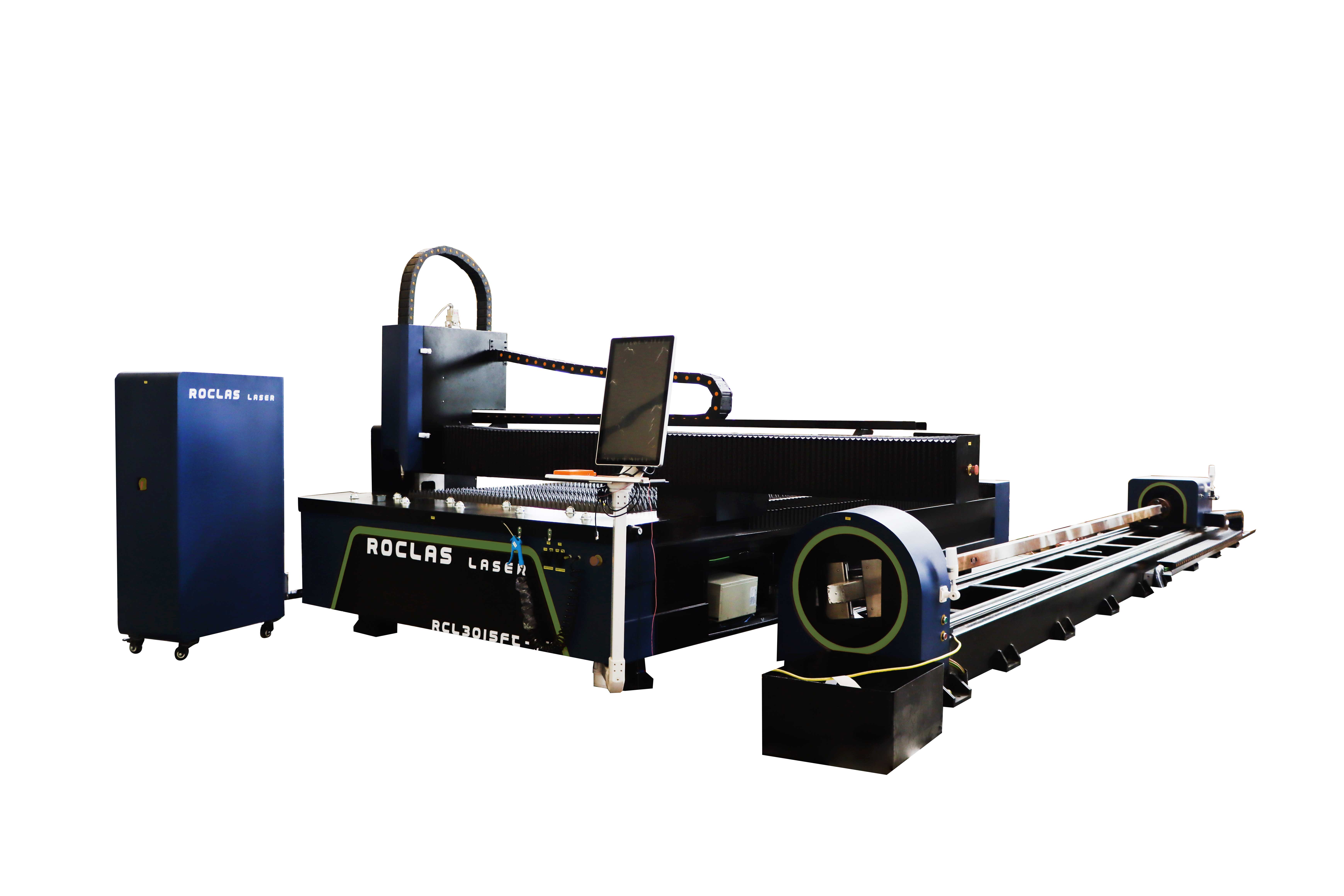
ROCLAS® MACHINERY CO., LTD. is a useful reference point here because its catalogue spans the full range under discussion: sheet platforms from 1 kW to 20 kW, dedicated tube machines with 220 mm maximum diameter and automatic chucking, and combined sheet–tube units running Cypcut 3000S. The company's stated manufacturing approach — heavy-duty steel structures finished on CNC five-face machining centres, with imported servo drives and reducers — reflects the specification pattern that has become standard among established Chinese builders targeting export markets. Its certification set (ISO 9001, CE, FDA, UL) is the practical entry ticket for European and North American distribution, and the 50-plus patent portfolio is a reasonable proxy for sustained R&D rather than catalogue rebadging.
Two design details are worth flagging for buyers. The first is the availability of modular, screw-connected bed construction alongside conventional single-piece welded beds. The manufacturing tolerance is claimed to be equivalent, but the modular version separates for transport — a real consideration for buyers in markets where a monolithic 4 × 2 m bed is difficult to move into an existing building. The second is the treatment of high-reflectivity stock as a supported process rather than an exclusion, which matters for shops doing electrical enclosures or decorative work in copper and brass.
The CO2-plus-fibre hybrid configuration deserves a brief note. A 500 W sealed CO2 tube paired with a fibre source on a 1500 × 3000 mm bed gives genuine all-material coverage — acrylic, wood, leather alongside steel and aluminium. For signage and mixed-fabrication shops this replaces two machines, though the CO2 side carries the usual consumable and tube-life considerations.
IV. Conclusion and Outlook
The competitive axis in fibre laser cutting has shifted from source power to system integration. Accuracy figures in the ±0.02–0.05 mm band are now table stakes; what separates platforms is how cleanly they handle mixed workloads, reflective materials, and non-metal stock without multiplying footprint. Builders positioned across the full sheet–tube–hybrid spectrum, ROCLAS among them, are betting that fabricators will consolidate rather than specialize. The caveat is service depth: an integrated machine that goes down takes both product lines with it, and the after-sales response — not the specification sheet — is what determines whether consolidation pays off. Buyers evaluating this class of equipment should weight validation trials on their own material mix and a documented service commitment at least as heavily as the power rating on the nameplate.
Hae lainaus
Riippumatta siitä, tarvitsetko yleistä neuvontaa tai erityistä tukea, autamme mielellämme.
Viimeinen viesti
-
 Robotic Arm Laser Systems: Redefining Precision and Flexibility in Industrial ManufacturingAbstractThe integration of robotic arms with laser processing technologies represents a paradigm s...2026-07-06 16:30:57
-
 Perimmäinen opas korkean suorituskyvyn kuitulaserleikkauskoneisiinIntroductionFiber laser metal cutting machines have transform the manufacturing industry with thei...2025-06-24 19:56:52
-
 Fiber Laser Cutting Automation in Metal Fabrication: Power Scaling, Precision Economics, and the Integration Challenge Across CNC, Woodworking, and Stone MachiningFiber laser cutting has moved from a niche alternative to the default sheet-metal processing route...2026-11-16 08:31:26
-
 Kuitulaserin ja CO2-laserin välisten keskeisten erojen ymmärtäminenLaserleikkauksen ja kaiverruksen maailmassa kaksi lasertyyppiä hallitsevat teollisuuden kuitulaseria...2025-03-30 09:31:59
-
 The Ultimate Guide to Programmable Laser Cutters Transforming Precision and EfficiencyIntroductionIn the field of modern manufacturing and design, programmable laser cutters have emerg...2025-03-29 09:32:00
-
 Paras opas teräksen laserleikkaustekniikoihin, hyötyihin ja sovelluksiinIntroductionSteel laser cutting has transform the manufacturing and fabrication industries, offeri...2025-03-24 08:31:07