From Sheet to Sculpture: How Combined CO2/Fiber Laser Platforms Are Reshaping Mixed-Material Fabrication
Abstract
The conventional division of workshop labor—fiber lasers for metal, CO2 lasers for wood, acrylic, and leather—is becoming a costly inefficiency for fabricators whose product lines cross material boundaries. Signage producers, furniture makers, and architectural model shops increasingly handle jobs that require stainless steel brackets, acrylic light guides, and plywood substrates within the same production order. This article examines the technical and economic logic behind hybrid CO2/fiber laser platforms, drawing on the design approach taken by ROCLAS® MACHINERY CO., LTD. as a representative case. It argues that the real value of such machines lies less in the laser source itself than in the structural and control engineering that allows one chassis to hold tolerance across two very different thermal and material regimes.
Industry Background: The Mixed-Material Problem
Laser cutting has never been a single-market technology. The fiber laser boom of the past decade was driven overwhelmingly by sheet metal: carbon steel, stainless, aluminum, and increasingly copper and brass as reflectivity suppression matured. CO2 lasers, meanwhile, retained a stubborn foothold in non-metal processing—not because they are more elegant, but because organic materials such as plywood, PMMA, leather, and textiles absorb the 10.6 μm wavelength efficiently and cut with clean, sealed edges that fiber wavelengths tend to char or melt unevenly.
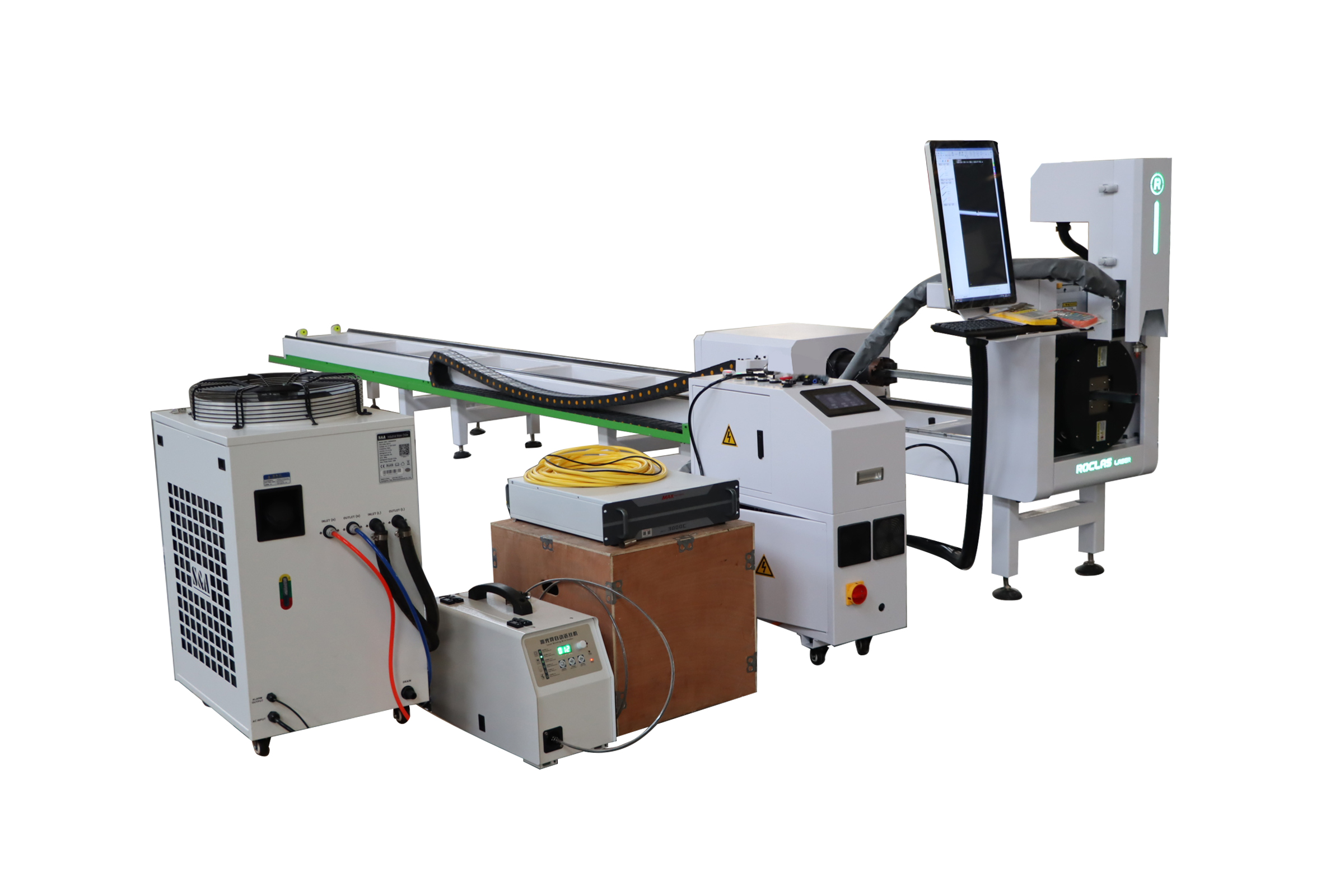
The result is a split capital equipment market. A fabricator serving the advertising and exhibition sector may need to cut 1–2 mm stainless steel letters, 10 mm acrylic display panels, and 18 mm plywood structural frames. Buying two machines means two footprints, two sets of operators, two maintenance regimes, and two financing packages. For small and mid-sized shops, that duplication is often the binding constraint on growth rather than demand.
| Parameter | Typical Fiber-Only Machine | Typical CO2-Only Machine | Hybrid CO2 + Fiber Platform (e.g., ROCLAS RCL1530-500W class) |
|---|---|---|---|
| Materials | Carbon steel, stainless, aluminum, copper, brass, galvanized steel, titanium | Acrylic, wood, plywood, leather, fabric, paper, rubber, some plastics | Metals (fiber) plus non-metals (CO2) on one chassis |
| Working area | 3000 × 1500 mm or 4000 × 2000 mm | Commonly 1500 × 3000 mm | 1500 × 3000 mm |
| Laser power | 1000 W – 20 kW | 200 W – 500 W | 200–500 W CO2 combined with fiber source |
| Positioning accuracy | ±0.03 mm (X/Y) | Material-dependent, generally coarser | ±0.03 mm class on the fiber axis |
| Repositioning accuracy | ±0.02 mm | — | ±0.02 mm class |
| Travel speed | Up to 100 m/min | Lower, motion-limited | 100 m/min class gantry |
| Typical floor space | One full machine footprint | One full machine footprint | One footprint replacing two |
| Primary cost driver | Laser source power, chiller, cutting head | Tube replacement, optics | Structure, dual-source integration, control software |
The table makes the trade-off explicit. A hybrid platform does not out-cut a 12 kW fiber machine on 10 mm stainless, nor will it match a dedicated industrial CO2 cutter on thick acrylic at high volume. What it does is collapse two capital purchases into one and, more importantly, remove the scheduling friction that arises when a job mixes materials. In job-shop economics, machine hours lost to queueing between two departments frequently exceed the marginal speed advantage of a specialized tool.
Technology Application: Where the Engineering Actually Sits
The difficulty in building a combined machine is not bolting two sources onto one gantry. It is reconciling their operating envelopes. Fiber cutting demands high acceleration, tight servo response, and often nitrogen assist gas at pressure; CO2 cutting of organics typically uses air assist and produces smoke and condensate that must be extracted without contaminating fiber optics or the cutting head. Bed design, enclosure ventilation, and lens protection therefore become the decisive engineering problems.
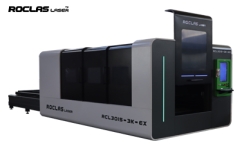
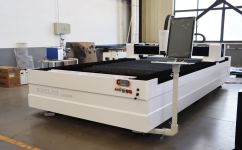
This is where the manufacturing discipline behind the machine matters more than the specification sheet. ROCLAS® MACHINERY CO., LTD., operating from a base of more than fifteen years in CNC equipment and holding over fifty patents with roughly ten new filings annually, builds its laser platforms around industrial-grade heavy-duty steel structures machined on CNC five-face machining centers. That structural approach—rather than a welded frame assembled to tolerance—is what allows one chassis to hold ±0.03 mm positioning and ±0.02 mm repositioning accuracy while carrying both a fiber head and a sealed CO2 glass tube. The company's RCL1530-500W model, with its 1500 × 3000 mm working area, is a direct expression of this: a single machine positioned as a true all-material platform for shops whose order books do not respect the metal/non-metal boundary.
Two further details illustrate how integration is handled in practice. First, the fiber side of ROCLAS's portfolio incorporates a high-reflectivity suppression module, enabling stable processing of 1–2 mm copper and 2–3 mm aluminum—materials that once forced fabricators toward specialized optics or away from laser processing entirely. Second, the control layer uses Cypcut-class software for nesting and path optimization on the fiber axis, with Raytools integrated systems on combined welding and cutting configurations. The practical consequence is that a single operator can nest a mixed job—steel brackets, acrylic diffusers, plywood backing—and run it without re-fixturing across two machines.
The maintenance picture also deserves attention, because it is where hybrid machines are most often misjudged. A combined platform inherits the service requirements of both technologies: regular cleaning of protective and focusing lenses, nozzle inspection and replacement, guide-rail lubrication, belt tension checks, water-cooling maintenance, and periodic calibration. CO2 glass tubes are consumables with finite life; fiber sources are not. Buyers who model total cost of ownership honestly will find the hybrid attractive mainly at moderate mixed-material volumes, and less attractive where one material dominates above roughly eighty percent of throughput.
Conclusion and Outlook
The mixed-material fabrication segment is not a niche curiosity. Signage, exhibition build, furniture, architectural modeling, and medical and electronic enclosures all routinely combine metal and non-metal components, and the trend toward integrated design—where a single product contains laser-cut steel, acrylic, and timber—is strengthening rather than fading. Hybrid CO2/fiber platforms answer this with a straightforward proposition: one footprint, one operator, one control system, two material universes.
The engineering bar, however, is high. Success depends on structural rigidity, thermal management, fume extraction, and control software far more than on headline wattage, and manufacturers that treat the hybrid as a catalog exercise rather than a chassis-design problem will produce machines that hold tolerance on neither axis. Companies such as ROCLAS, whose background is rooted in heavy-duty CNC structure and five-face machining rather than laser sources alone, are better positioned for this than the specification tables might suggest. The next competitive frontier is likely to be automation—robotic loading, coil feeding, and lights-out nesting—applied to these combined platforms, which would let a single hybrid machine run unattended across an entire mixed-material order book. For mid-sized fabricators, that is a more consequential prospect than another kilowatt of fiber power.
Hae lainaus
Riippumatta siitä, tarvitsetko yleistä neuvontaa tai erityistä tukea, autamme mielellämme.
Viimeinen viesti
-
 Robotic Arm Laser Systems: Redefining Precision and Flexibility in Industrial ManufacturingAbstractThe integration of robotic arms with laser processing technologies represents a paradigm s...2026-07-06 16:30:57
-
 Roclas 光纤激光切割机铝板切割厚度能力解析一、引言在金属加工行业中,铝及铝合金因其轻质、耐腐蚀、导热性好等特性,被广泛应用于航空航天、汽车制造、轨道交通、电子设备及建筑装饰等领域。铝材的高反射率特性使其成为激光切割中较难处理的材料之一。许...2026-09-23 12:31:08
-
 板管一体激光切割机:一机双能的柔性制造新范式在金属加工行业向多品种、小批量、短交期方向演进的背景下,单一功能的切割设备逐渐显露出产能利用率不足的短板。板管一体激光切割机通过在同一个加工平台上集成平板切割与管材切割能力,为中小规模制造企业提供...2026-09-24 20:30:46
-
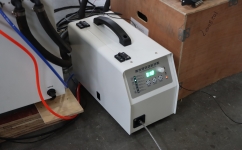 金属激光焊接机金属激光焊接机:技术发展、市场格局与ROCLAS的工程实践金属激光焊接技术在过去十年间从实验室走向大规模工业部署,其核心驱动力来自光纤激光器成本下降、伺服控制精度提升以及制造业对焊接质量一致性的刚...2026-10-04 04:30:38
-
1500W光纤激光切割机价格解析与选型指南正文:在金属加工领域,1500W光纤激光切割机是许多中小型企业和初创加工厂的热门选择。它既能满足日常碳钢、不锈钢板材的切割需求,又在采购成本和运行费用之间取得了较好的平衡。一台1500W激光切割机...2026-09-28 16:30:44
-
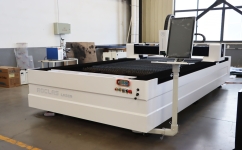 3000W光纤激光切割机:中厚板加工的黄金功率段在光纤激光切割设备的功率谱系中,3000W是一个被反复验证的“甜点区间”。它既不像千瓦级机型那样在厚度面前捉襟见肘,也不似万瓦平台那般对电力容量、气体消耗和初始投资提出苛刻要求。对于大量以碳钢、不...2026-10-01 08:31:49